Welcome to Ampinvt !
 Products
 Partnership
  Contact
In the realm of solar energy systems, charge controllers play a crucial role in regulating the flow of electricity between solar panels and batteries. Among the various types of charge controllers, solar charge controllers and MPPT (Maximum Power Point Tracking) controllers stand apart, each offering distinct advantages and applications. This article delves into a comprehensive comparison of solar charge controllers vs. MPPT controllers, shedding light on their differences and guiding readers in choosing the optimal option for their specific solar setup.
Functionality and Efficiency
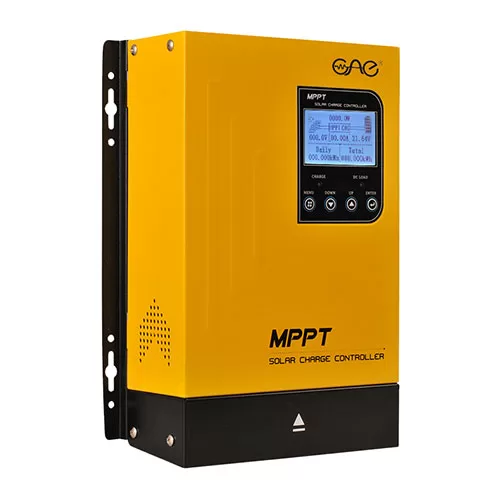
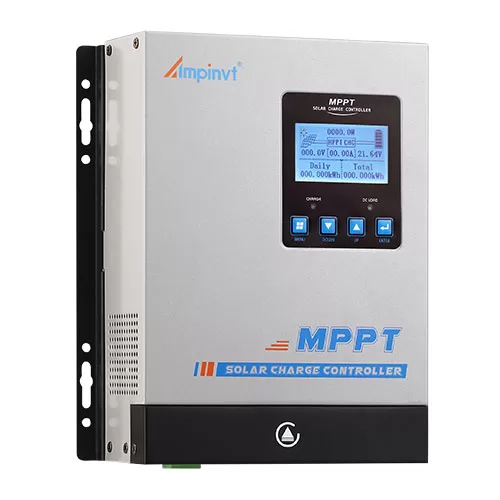
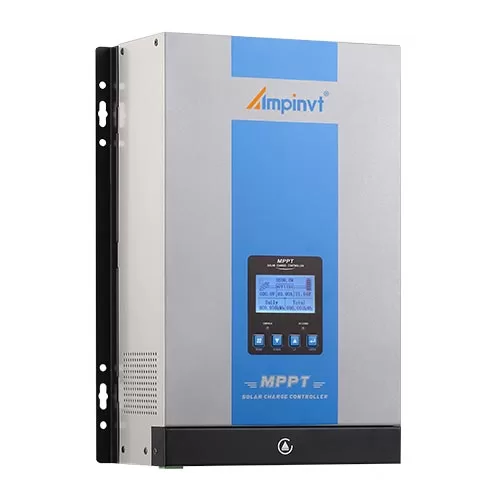
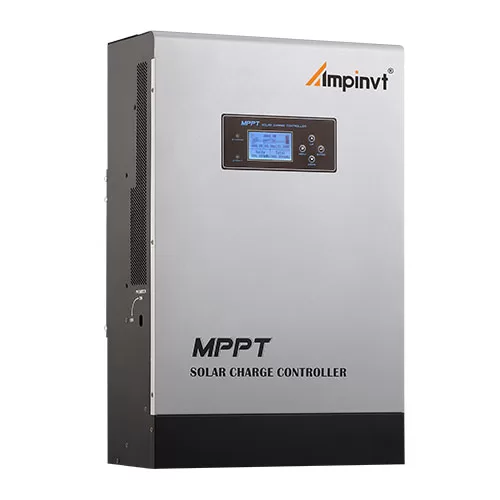
Solar charge controllers monitor the battery’s voltage and prevent overcharging by diverting excess power from the solar panels. MPPT controllers, on the other hand, take this functionality a step further. They constantly adjust the input voltage from the solar panels to match the optimal operating voltage of the battery, maximizing power extraction. This advanced feature allows MPPT controllers to harvest up to 30% more power from the same solar panels compared to conventional solar charge controllers.
Cost and Complexity
Solar charge controllers are generally more cost-effective than MPPT controllers. However, the enhanced efficiency and power output of MPPT controllers may offset the initial investment in the long run, especially in large-scale solar systems. The higher efficiency of MPPT controllers reduces the need for additional solar panels, potentially saving on overall system costs. Additionally, MPPT controllers often require specialized knowledge for installation and configuration, adding complexity to the overall system.
Suitability for Different Systems
Solar charge controllers are suitable for small-scale solar systems, such as those used in RVs or boats. They are cost-effective and can handle the power requirements of modest solar setups. MPPT controllers, on the other hand, are ideal for larger solar systems where maximizing power output is critical. They are particularly beneficial in systems with limited roof space or in areas with variable sunlight conditions. The advanced tracking capabilities of MPPT controllers ensure optimal performance even under fluctuating solar irradiation.
Benefits of MPPT Controllers
Increased Power Output: MPPT controllers harvest up to 30% more power from solar panels, maximizing the system’s energy yield.
Improved Efficiency: They optimize the charging process by matching the input voltage to the battery’s optimal operating voltage, reducing energy losses.
Suitable for Large Systems: MPPT controllers are ideal for large-scale solar installations where maximizing power output is paramount.
Benefits of Solar Charge Controllers
Cost-Effective: Solar charge controllers are typically more affordable than MPPT controllers, making them a suitable option for budget-conscious applications.
Simple Installation: They are easy to install and configure, requiring minimal technical expertise.
Suitable for Small Systems: Solar charge controllers are well-suited for small solar setups, such as those used in RVs or boats.
Conclusion
The choice between solar charge controllers and MPPT controllers depends on the specific requirements and budget constraints of the solar system. Solar charge controllers offer a cost-effective solution for small-scale systems, while MPPT controllers excel in maximizing power output for larger installations. By understanding the differences between these two types of charge controllers, readers can make an informed decision that optimizes the performance and efficiency of their solar energy systems.

COMPANY
PRODUCTS